


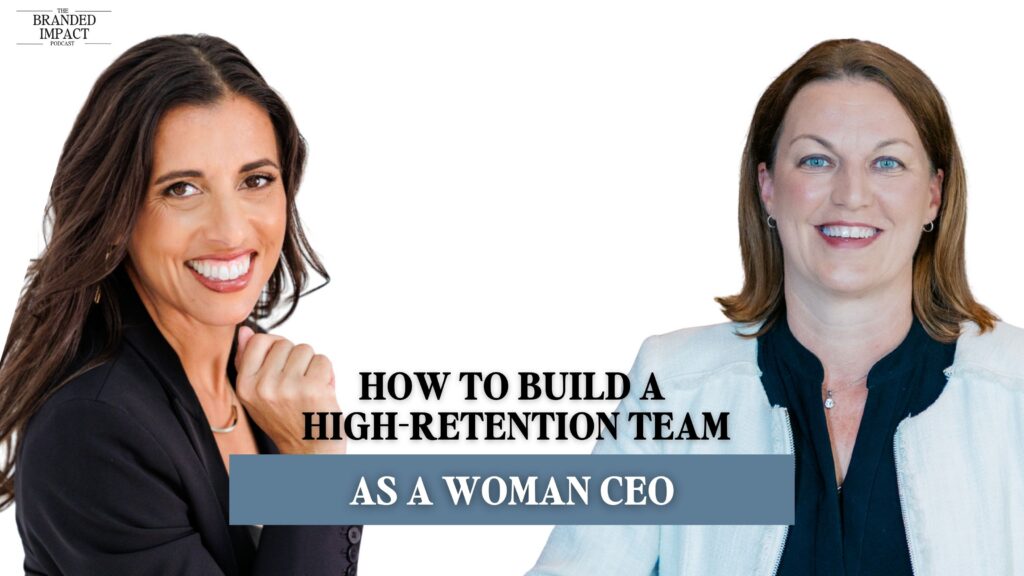
Building a high-retention team for women CEOs requires more than hiring well. It demands intentional leadership, mentorship systems, and operational clarity that support sustainable growth.
In this episode of The Branded Impact Podcast, Jo Espejo, Founder of Branding by Jo, sits down with Wendy Sellers, widely known as The HR Lady®, to unpack what it truly takes to retain strong teams while scaling authority.
Together, they explore what it truly takes to build a high-retention team and why retention is directly connected to sustainable growth, CEO mindset, and long-term brand authority.
If you are building a team or preparing to scale, this conversation will reshape how you think about mentorship, hiring, and leadership development.
Scaling should never cost you your culture, your people, or your momentum.
This episode connects brand strategy with operational clarity so growth feels stable instead of chaotic. Listen on your favorite podcast platform or watch on YouTube to learn how to build a team that strengthens your visibility and authority.
Key Takeaways
- Mentorship increases employee engagement and retention
- Company values must guide hiring and performance systems
- Personality styles influence communication and leadership effectiveness
- Strategic training reduces long-term turnover costs
- Branding and SEO amplify authority and business growth
How to Build a High-Retention Team as a Woman CEO
Why Mentorship Strengthens a High-Retention Team for Women CEOs
Retention is not simply an HR metric. It is a growth strategy.
Employees who receive mentorship are significantly more likely to remain with organizations that invest in their development. Research consistently shows that mentees report higher engagement and lower turnover than those without structured support. Mentors benefit as well. Many experience stronger engagement and a deeper connection to the company mission.
For women entrepreneurs scaling their businesses, mentorship becomes a leadership multiplier. It stabilizes growth while strengthening culture and team alignment. Rather than treating mentorship as optional, consider it a core leadership system.
The Leadership Mindset Shift
Many founders believe they must personally train every team member. Wendy challenges this belief.
Strong CEOs understand that their highest value is not always in direct instruction. Sustainable leadership requires humility, clarity, and strategic delegation. Bringing in outside expertise can be a smart move. Investing in structured training programs reduces confusion across the team and prevents burnout at the leadership level.
Intentional leadership development creates consistency. Reactive leadership often leads to turnover.
Using Company Values as a Scorecard
Job descriptions should accomplish more than listing tasks.
High-performing organizations integrate company values into hiring criteria, onboarding processes, and performance evaluations. When expectations are anchored in values, alignment becomes natural. Clear communication improves. Client experience strengthens. Brand consistency deepens.
Operational clarity reinforces brand authority.
Personality Styles and Communication
Understanding personality frameworks such as DISC can significantly improve leadership communication.
Some team members respond best to direct instruction. Others thrive with relational context and collaborative dialogue.
Adapting your communication style builds trust. Increased trust supports retention. Strong retention protects business momentum.
When leadership communication aligns with individual strengths, culture stabilizes.
Branding, Visibility, and Authority
Wendy shares how she built her brand as The HR Lady® through SEO, content strategy, and consistent positioning. Branding is not a one-time effort. It requires sustained visibility and intentional authority building. Clear positioning attracts aligned clients and team members. Strategic visibility reinforces credibility in the market. When leadership and branding align, scaling becomes intentional rather than exhausting.
Frequently Asked Questions
What defines a high-retention team?
A high-retention team is built through mentorship, structured training, value-based hiring, and consistent communication systems. Employees remain long-term because development and culture are prioritized.
How can women CEOs reduce employee turnover?
Effective strategies include:
- Implementing structured mentorship programs
- Investing in leadership development
- Embedding values into hiring and evaluation systems
Does mentorship improve retention?
Yes. Research consistently shows that employees with mentors report higher engagement levels and lower turnover rates compared to those without mentorship support.
Guest Resources
Explore Wendy Sellers’ work at:
Website: thehrlady.com
LinkedIn: Wendy Sellers, The HR Lady®
About The Branded Impact Podcast
The Branded Impact Podcast, hosted by Jo Espejo of Branding by Jo, helps women-led businesses align visuals, messaging, and systems so they can show up confidently, sell with clarity, and scale with intention.
Explore Branding by Jo at www.brandingbyjo.com
Full Transcript of Episode 35: How to Build a High-Retention Team as a Woman CEO featured guest Wendy Sellers, The HR Lady® on The Branded Impact Podcast
00:00 The Importance of Training and Mentoring
02:54 The Role of Mentorship in Leadership
05:04 Building a Strong Brand
07:38 Effective Hiring Practices
10:09 Understanding Personality Styles
12:45 The Value of Employee Retention
14:56 Leveraging Team Strengths
17:37 Resources for Business Growth
26:59 JO OUTRO_v2.mp4
Jo Espejo (00:18)
You can grow your brand, but can your leadership keep up? Most women entrepreneurs overlook the thing that impacts retention, culture, and revenue the most. Welcome back to the Branded Impact podcast. Today, I am talking with Wendy Sellers, the HR lady. She is a real, reliable, realistic voice in HR who helps leaders build teams that actually stay. companies that invest in inclusive leadership training are 4.2 times more likely to outperform financially.
let’s talk about why training and mentoring, are actually what move the needle. Wendy, thank you so much for joining me today. Of course, can we start with when did it click for you that training and mentoring were the true unlocks for leadership?
Wendy Sellers (00:51)
Sure, thanks for having me.
for me that I’m a person who I grew up in an area that it wasn’t highly educated. I decided to go all the way and get two master’s degrees, the second master’s degree, I went back to get in the human resources because I realized I did need more training. then even with all those formal education, you still need the mentoring because you need the mentoring on like, how does this culture work? How do I fit in with the mission, vision and values of that company and that culture?
I would say early in my HR career when I thought I was like, I’m so educated. have all these degrees and certifications and licenses and I could do everything, anything I want. I need help. I don’t understand this little tiny thing in the company handbook that I wrote, it’s really important to just, for us as experienced people to stop for a hot minute, stop judging people.
It could take a 20 minute mentoring session or could be a formal six month program. just starting to get mentorship, mine was informal, even though it was from a formal person above me on the org chart, but it was very informal, but it helped me so, so much. Just really figure out what kind of company am I in and where do I fit?
Jo Espejo (02:04)
there’s a very big difference because I went to school, I got my degree, I got a master’s. Once you start actually applying what you’re trying to learn, it’s like, yes, I’ve got it. in a school setting or in a classroom setting or in a training session, it’s like, yes, yes, yes, that all makes sense. then you go to apply it and it’s not all perfectly curated in this little box to fit that exact scenario that we were taught. And the mentoring piece, what’s blowing my mind is the more that I get involved. I do masterminds.
I am consistently working on elevating my own knowledge in what I’m doing because you need that upper hand, somebody giving you a different perspective and working with someone who’s already been there, done that and helping you shorten that learning curve. the more that I start to stay attuned to that, I start to realize even the successful, very great people, if you start listening to their stories, they’re worked with a mentor or I worked with this or I did a mastermind and that’s
I jumped from here to here. mentorship is key across all the boards. We just tend to forget it.
Wendy Sellers (03:00)
especially in this country, those formal degrees or licenses or certifications. I’m not knocking them. Like I said, I have three degrees and every certification there is known to man, but we need that human interaction, that HR part, that we have these called humans. it’s not just about, what’s in our brain. We also have emotions and we need to have empathy and we need to learn how to be like,
this person that’s coming in my office right now is crying and I should probably not, rip them a new one right now. Maybe I should talk about something else. that’s where the mentoring comes in where you can say, I still can hold this person accountable for not being the best employee or acting like a fool, but not right now, because now is not the time. They’re coming in talking about a death in the family or an illness or something like that. I just think you learn that by a really great mentor.
or unfortunately getting egg on your face and going, well, I never want to have to deal with that again, right?
Jo Espejo (03:49)
I think sometimes too, the other shift that I’m seeing, and especially in my space where we have a lot of entrepreneurs, is you think that you can do everything yourself. then there’s that struggle between now that I know I need to bring someone on or I want to train, it’s like, what is the best way? I don’t know if you find this too, but a lot of times the biggest hold back is one, we don’t think anyone else can do it the way that we can.
Or really, it’s just you don’t really know how to train, you sit down to look at the SOPs or the standard operating procedures a lot of us as entrepreneurs don’t even do that. We just have a way that we like to do things. It’s been trial and error. We got egg on our face. We fell flat on our face. We got up, we did it again. then you go to train someone and you’re like, you just kind of do it.
Wendy Sellers (04:09)
Yup.
Jo Espejo (04:27)
Now I have to take that step back and actually take some time. this is the key for mentorship too. You have to have the time and the patience to be able to train someone and not just train them how you like to be trained, train them on how they like to be trained.
Wendy Sellers (04:39)
which means you might not be the best trainer for them. You may need to get somebody else to train that person because they’re of a different learning style and maybe you don’t have any patience or completely different personality traits or personality styles. even in the generational aspect too, you just may not be the trainer or the mentor for that person. I wanted to just quickly mention some statistics related to mentors and mentees.
Jo Espejo (04:43)
interesting.
Wendy Sellers (05:04)
retention rates for mentees, so those people that have been mentored internally are 72%. how we are all struggling to attract and retain employees, whether you have two employees or you have 2,000 employees, we want to retain them. if you’re mentoring them, hopefully formally-ish, you’re going to have a 72 % retention rate. for the mentors, the people that you’re teaching how to be a mentor and then you’re assigning them to be a mentor.
They have a retention rate of 69%. that is amazing. you’re asking people to give back to the internal organization and then they still stay. you form these relationships. when people are offered another job, maybe they’re not even looking for it, but they’re like, hey, come work for me. I see you on LinkedIn, They say, no, I have these really great relationships at my company because I am a mentor or I was a mentee.
I’m gonna stay there and stick it out a little bit longer.
Jo Espejo (05:56)
you’re forming those relationships and it’s like that buy-in as far as wanting to be able to give back. that’s when it comes into those core values. are you really tied in? Do you feel like you’re just punching a clock? Are you just another number or are you valued and really feel like you’re contributing to the company? we can all do our jobs, but then I guess this is a part that I know for me when I’ve been the both the mentee and the mentor.
I take a lot of stock in, I’ve really helped and I really feel like I can contribute. it’s more than just a paycheck and it’s more than just a job at that point. when you decided to do this business, what are some of the first things that you did to really establish your own brand? And then what have you done as you’ve evolved to kind of keep that going?
Wendy Sellers (06:34)
when I opened the HR lady, it was my third business all HR consulting, I started on my own. Then I had some business partners and then I want to go back to my own. I was like, you everybody always just calls me the HR lady. I wonder if anybody out there has that brand. some people had it like here and there on their profiles. I was like, I’m going to get the trademark, that way nobody else can have it. I got two trademarks on it and
that when people ask me what my title is now, I’m just like the HR lady. it’s pretty easy to figure out because that’s what everybody has always called me. When I started in my HR career, I kind of landed in HR. I didn’t, it wasn’t really like, put me in HR. You gotta be a little crazy to go into HR on your own, right? we didn’t have titles at that company. was a small, small company that grew and grew and grew and grew into an international firm. I was just referred to as the HR lady.
I did a lot of SEO. like paid SEO search engine optimization for anybody that doesn’t know what SEO is. when you’re searching on Google and go and find me the HR lady, Wendy Sellers will come up. a lot of things on leadership training, management training, and then HR consulting. it’s a lot, it is so time consuming to do branding. I was thinking about it this morning and I’m like, I feel like sometimes half my job is still.
Jo Espejo (07:38)
Mm-hmm.
Wendy Sellers (07:44)
social media, blogs, branding, tags, know, responding to media requests. if you don’t do it, you got to pay somebody else to do it, which is fine. either way, it’s time consuming and expensive, but it’s totally worth it because if you’re the first on the first page of Google or some other internet search, when somebody is looking for, in my case, an HR consultant, leadership training, I do a lot of conference speaking, it makes a lot easier for me to make money and pay some bills.
Jo Espejo (08:10)
If you’re coming up in the searches. I think it’s very clever. I love that it came out of like what you were being called. Cause I think that’s how branding by Jo came about too. I used to just use my name then I started to morph into branding. when I finally niche down, I think I was at an event and somebody was like, if you haven’t had your branding done, you need to make sure you connect with Jo. Branding with Jo, And I was like, that’s perfect. That establishes what I do in my name
Wendy Sellers (08:13)
Thank you.
Thank
Jo Espejo (08:33)
this is where the SEO piece comes in too. If your name is what people are Googling, it helps because that’s one more touch point. it’s like you said, it’s not a one and done. You didn’t just register your name get your website. that’s it. My branding is done. No branding is a consistent effort. Like you have to put in. It is.
Wendy Sellers (08:38)
Yes.
Nope.
Time
consuming, very time consuming, but it’s worth it because like you just said, somebody else usually brands us. Unless it’s a negative terminology they’re using, go with it because that’s what everybody’s referring to you as. Just go with it or make it a tagline or something like that if you can’t change your entire company name.
Jo Espejo (09:07)
you mentioned it’s time consuming. Creating content is time consuming. We spend a lot of time thinking about how we want our messaging to come across, listen to what people are saying already, and then use that in your messaging. if there’s something called the HR lady, for you to go out and try to come up with some convoluted name of what you’re going to call yourself doesn’t make any sense. Just going with what people were already saying.
is perfect. I have another one. It’s a tagline I use or I way I introduce myself now. I’ll say I’m a brand amplifier. It was a client that said that to me in an introduction to somebody else. This is Jo. She’s our brand amplifier. I was like, that is phenomenal. I’m going to use that. that was out of the client’s words, I don’t know if I could have come up with something so creative. I was like, I like amplify. but sometimes we make our job that much more difficult. I recommend you talked about Google.
Wendy Sellers (09:41)
Yeah ⁓
Jo Espejo (09:50)
and SEO and all these pieces. One of the best ways that you can do that is through reviews because Google loves to hear from the people that you’re actually working with, not just what we’re putting out there, but people. when you ask people to do a Google review, that’s going to help your SEO, look at the words that they’re using to describe you in the review and then use those words in the content that you’re creating, whether that be a blog post or LinkedIn or Instagram, whatever, but use the words of your clients because that’s what other people are going to resonate with.
Wendy Sellers (09:54)
Mm-hmm.
Right.
that’s good advice. the words of your fan club, then you can grow your fan club even bigger.
Jo Espejo (10:20)
using words that’s like, get to be a little creative and especially in the branding world. I want to be really cutesy and like creative and I want it to stick and I want it to pop. then I say it and people are like, I don’t know what you’re talking about. I spent so much time trying to create this, fun new package name or whatever. I’m like, guys, sometimes you just have to keep it really simple. Like getting too creative sometimes can make it very convoluted.
One of the questions that I think comes up to mind with me when I start to think about growing my team how do I get my brand and my values and all the things to carry through? what are some recommendations as far as if you’re thinking about bringing someone on, what are some things that they should have in place? once they do,
What are some of the key things that you find in that mentorship piece that can really make a difference between a team member really understanding your brand and your core values?
Wendy Sellers (11:06)
I’m going to back it up a little bit to the interviewing process, even before the interviewing process, the job posting process. I truly believe that most companies are not using job descriptions in the way that they should be used. They’re like, here’s a list of duties. then they never look at them again, right? They hire somebody, they maybe look at them once a year during those annual performance reviews. I tell all of my clients, I want your company values in the job description.
Here’s who you report to, here’s your title, here’s the list of essential duties, non-essential duties if you have a disability as well, all the knowledge, skills, and abilities that are required. here are also our company values, which are aka expected behaviors in the workplace. They’re usually words like respect and transparency and professionalism, or they might be entire sentences. if you have them in your job description, then that job description is going to be created into a job ad. that job ad is going to be created into a list of interview questions.
I just put it all in an Excel sheet and make it into a scorecard. I use that same exact interviewing, for the reviews too. we’re going to judge somebody in the beginning by asking them, here’s all the knowledge, skills and abilities. Can you do these duties? Do you understand what these behaviors mean? Explain to me a time when you did blah, blah, blah. you just keep using that over and over again, updated, of course, if anything changes in the job description, your people.
will get used to kind of like, all right, we’re going to have once a year reviews. No, please, please do more than that. Please do at least like four feedback sessions. They don’t have to be called reviews, but who the heck wants to wait 364 days to get another feedback from their manager? Right. A performance of behavior in one document, you create into a scorecard and use it for every piece of feedback, internal interview. If you’re looking, for a step up.
it’s gonna be a lot easier for the mentors to scratch their head and go, what am I supposed to talk to these people about? let’s look at their job description, and let’s look at the company values. Does that make sense?
Jo Espejo (12:53)
that makes sense to me. I think honestly, it’s just being clear and being, you’re basically putting out a roadmap then it gives you words too. this is what I like. that was phenomenal because I know for me, sometimes when I’m interviewing somebody, a lot of it comes down to like this gut check. do I feel like you and I align? Do I like your personality? I’ve always said, I was in operations management for 16 years and every time I recruited, I will hire for personality over…
Wendy Sellers (12:56)
Yeah, it’s crystal clear.
Jo Espejo (13:17)
aptitude any day because you can train some skills. Personality, you that’s you got it or you don’t. That’s just going to be the thing. There’s some positions where, especially like in a dental office, if you are a very serious and non-friendly person, putting you at the front desk position that has to greet every single person that comes in the door, that’s going to be a challenge all the way around. It’s a challenge for the person sitting there. It’s going be a challenge for all of our patients. we’re going to be like, but why aren’t you bubbly and saying hello? It’s like, well, that’s not my personality.
Wendy Sellers (13:37)
Yeah.
it really is. I’m so glad you brought that up because I literally just came back from the dentist like 20 minutes ago before this session here. it is I sit there and I’m like, I like my dentist. I like the people in there. I love that you’re talking about personalities. I wrote two books. My one book is Suck it Up Buttercup, Be a Leader, People Will Follow. I talk about, personality styles in there a lot. I’m trained on a disc, which is like a derivative of Myers-Briggs.
I truly believe that, most people, their personalities lead them to a career, you could also have any personality style and go in any, any career that you want. Is it going to be a little bit more difficult for you? probably. That’s why most of us naturally go into one career that, requires a personality like you were just mentioning. there’s also like personality traits, extrovert, introvert, ambivert. I write about that in my other book. When I first did.
the disk training for personality assessment before I got certified. I just went to like a webinar back then it was in person and I was like, my goodness, I’m the problem. It’s me. I’m like, it’s my personality. I’m dominant. I’m direct. I’m bossy. you get people to do what you want them to do, Wendy, but doesn’t mean they’re willing to do it. They have to cause you’re their boss. I grabbed that mirror and was like, you need to make some changes.
not change your personality, there’s nothing wrong with it. I needed to learn how to adjust during certain conversations with this person over here, try to take a step back and say, you’re not supposed to be the one in control in this meeting, Wendy. It completely changed my life when I first did that training. I use it to change other people’s lives now too, and help people zip it when necessary or speak up when necessary.
they may need to role play it a little bit and that’s where mentors could come in as well.
Jo Espejo (15:21)
I did the disc as well a long time ago. I actually got to go to North Carolina and studied under like the Bell Leadership Program and all that stuff. was eye opening, the difference. And even now for me, like I tend to be a DI. I like to be very direct and then I’m also kind of social, but in the workspace, I tend to fall into that like very direct world. when I work with a lot of S’s who are like,
Wendy Sellers (15:28)
no!
Jo Espejo (15:43)
very go with the flow. don’t like change. They like stability. They like the culture. They do own that. I can’t even tell you how many emails I’ve started to write. I’m speaking to so-and-so who’s an S. Let me back up and start with, hi, how are you today? How was Okay, let’s dive into what’s an update on this thing or whatnot the other versus my personalities that were very direct. I didn’t have to do the hi, how are you? I could just be like, hey, give me an update on XYZ.
Wendy Sellers (16:07)
literally did it this morning before, before
my dentist appointment, I was writing, a podcast agenda. Cause I have a podcast too. you know what? I don’t know this, this gas. better start with that. Hey, how you doing? Just so you know, the information’s below where I had another agenda. I was writing, was like, they know me. Hey, here it is CFI.
Jo Espejo (16:23)
as I’m thinking about this, going, man, I didn’t really apply this into when I’ve been hiring with words, right? I don’t think I really realized that I was doing it because it’s one of those things that’s been so ingrained with me over time. this is one of the recommendations and I’m thinking that we can apply it to those who maybe are in that more solopreneur space, having the smaller teams. If you’ve got the bigger teams, this is a phenomenal tool. if you’ve never heard of it, reach out to Wendy because it really is game changing for management.
to be able to know what personality styles not only that they have, but the employees. I feel like in the smaller spaces though, this is an excellent opportunity for you to evaluate everything that you do in your day to day. then really taking ownership of what are the things that you like to do and what are the things that when those come up on your to-do list, you find any excuse possible to shift it over or like your life. that’s where you start outsourcing any of those like task items that you’re like,
I hate life when I have to get to do this because I wanted to go out on my own, but I didn’t realize that meant that I was going to have to be the accountant and all the things. that’s my recommendation for when you’re thinking about bringing on a team member, I always say, where’s your zone of genius and where do you thrive? anything that does not bring you joy needs to make it to your top of the list of who am I going to hire? then figure out of that, like what’s a priority? you’re not always going to find somebody who fits
Wendy Sellers (17:34)
Yeah,
Jo Espejo (17:38)
all of the boxes, start with the ones that are the most pressing then you work your way through. for me, I’m like, my gosh, but actually putting a label to that, Wendy, I totally have forgotten all about that, but I absolutely love it.
Wendy Sellers (17:47)
For those that are listening, if you don’t know what DISC is, the DISC stands for dominance, influence, steadiness, and conscientiousness. the DI are very active and fast-paced, then the CS are much more moderate-paced and methodical. the D and C, they’re like in a big circle, are much more fact-based, where the I and the S are much more feeling-based as a priority. I don’t want you to ever…
Jo Espejo (17:57)
Thank
Wendy Sellers (18:11)
judge somebody and say, well, they’re odd. They have to be in sales. they probably naturally will go that way, but that doesn’t mean they have to. It just may be a little bit more difficult for them to overcome. that’s where a mentor comes in to where they can say, regardless of my personality style, regardless of my personality trait, I’m new at this role or I need help with this role and I’m embarrassed about asking for help and a mentor could really help.
I know some people that are listening might be saying, well, I don’t want to take my valuable employees offline of working on projects or products to mentor somebody else. remember what I said in the beginning is the mentors tend to stay longer as well. it’s a retention tool. It’s an employee engagement tool. now it’s going to cost your company less money in the end,
when it’s happening, you’re probably going, my goodness, why am I having them do a mentoring? I rather than having them do work product. It’s like you’re building into the long-term engagement and retention of your employees.
Jo Espejo (19:04)
even on the front end of a training, I was just having this conversation with a company that I’m doing consulting for. when you bring on a new hire, if you could take the time to train in the beginning, it is more painful, especially when you’re a smaller business that you feel every position, like not having full productivity. but you drag out the pain longer because if they’re not trained and if they’re not, and then the turnover cost, I think people underestimate how costly it is to have to replace somebody.
Wendy Sellers (19:27)
since the pandemic, it’s more costly than ever just to put an ad out. Nevermind, to now pay somebody on staff or, an external recruiting firm to say, you got to go through these hundred resumes that you get. it’s very, very time consuming and it’s very expensive because time is money, whether it’s internal or external recruiting.
Jo Espejo (19:31)
Yeah.
So much of it can go into place. this is where I’m like, I love also outsourcing some of these pieces because there’s so much that can go into it. if you can hire the right person on the front end then even to like, if you’re not really sure what that looks like, kind of doing a recheck for yourself, what are those values? What do you want your company to be known for? can you find employees who align or fit or compliment? for me, I really need someone in my life who is on my team that’s helping keep me a little bit more grounded and like,
We still need to do X, Y, Z, because I’m a very big idea. I like to be fast. let’s get it done. I need someone who’s like, OK, cool. I’m going to make sure, though, that between A and Z, we hit the steps that we need to get there. can we make it through the steps? I’m very high level. I’m like, let’s get it. I’ve got this big idea, big pictures. I’m very direct.
Wendy Sellers (20:21)
Hit the rest of the
Jo Espejo (20:29)
then I joke because I’m like, I want to know enough to understand, but I don’t want all the details. I need the very detail oriented person. can I be, you spoke to this earlier, can you be a little bit of every piece of it? Absolutely. Because there are days and times when even though I’m a DI and that means I like direct and I like fast paced and I’m very like high energy, there are still times when I want all the details. then there’s a lot of times when you start to hit on me with all the details,
Wendy Sellers (20:50)
Mm-hmm.
Jo Espejo (20:55)
I’m like, okay, you lost me.
Wendy Sellers (20:57)
if I have to do some work that’s like really detail oriented, like accounting, like you just said, even though I have an accountant, I have to do it first thing in the morning before my energy level has gone through the roof. I’m like, nope, can’t concentrate on that now. I can’t even have my coffee yet. Like, no, I’ve got to do this. I’ve got to sit still and think. if I can’t do it, then I need to outsource it because I’m not capable of doing this.
Jo Espejo (21:19)
on knowing, taking a pulse for like, what do you keep pushing off? they know for me with the branding, that’s something that I find a lot of companies push off first, because it does, it’s expensive. It does, whether you take that expense as it takes your time, because our time has a value to it as well. if you’re spending all of this time creating your own content, doing those pieces, you have to decide, is that where you really should be spending your time? if you do have the time, fantastic. when you find that that’s something that you’re putting off,
then now it’s gone from one week to two weeks to I haven’t posted consistently or I haven’t done anything. then where am I dropping in all of the rankings? if I don’t feel like I have something nailed then something new comes out, like it used to just be SEO. and open AI and all those things are making summaries. you also have to not just be coming up an SEO.
you have to be coming up in the artificial intelligence searches. so life is a fun and constant, never improving game, or constantly improving game of figuring out what’s next and what do do best. I like to recommend, as always, stick with your zona genius. I want to circle back to something you said earlier. You may not be the best person to train.
Wendy Sellers (22:22)
You might be the smartest person. You might be the owner of the company, but you may not be the best person to train. even me, mean, my career is training. do conference speaking. I do online training all day, every day. I have an LMS system, learning management system. But for a certain person…
I may not be the right person because I talk too fast. I’m too direct. Maybe I don’t have patience for that person. I don’t have patience for a whole lot of people. that’s a personality style. I know even when I’m dealing with somebody that I’m mentoring by choice, there’s some times that I’m like, have to speak with him or her or them at a certain time of the day so that our personalities align.
or it can’t be on a Monday, for example, because that’s when everything goes wrong in HR, right? it’s super important to just really be realistic and say, you know what, I’m not the right person for the job of this person. Maybe I intimidate that person. they’re the whole time so nervous that they’re not even listening and I need to get somebody else involved. we have to grab that mirror. like I said earlier to go, you know what, maybe I’m part of the problem here. So let me be part of the solution back out of this situation and get somebody else involved or.
Maybe I need a mentor on how to mentor somebody else. Maybe I need coaching and training, regardless of who you are, on how to deal with that specific type of person.
Jo Espejo (23:34)
just being open to the fact that there could be or there should be different approaches for different people. for me, my experience, I could train somebody, but there’s been seasons in my life where I’m bringing someone on where I just know my bandwidth is not there. I’ve identified opportunities for them to get additional training. that doesn’t always look like another person per se. I know when I brought my virtual assistant on, I wanted her to take over some tasks on social media. Like, OK.
I want help creating some content. I’m going to give you the pillars. I’ve got the strategy. I know exactly what I want it to look like, then I wasn’t able to give her additional tools. I actually had found some courses that I was like, okay, this is a course that you can take. This is someone who has taken the time and is an expert in the subject matter. Now I paid for the course and I just asked, and I paid for her to take the course. here you go. Here’s access. getting help and getting mentoring can look like different versions depending on
where you are and what phase you are. Now, once you get to the point that you’ve got employees, plural, and then you can identify, I like to say just because someone is really good at their job doesn’t mean that they’re going to be a good trainer. you have to identify the people within your organization that are not only good at their job, but can also train and then give them that ability. honestly, you’re right. They love it. when you ask people and they’re confident and they have that right personality, they really do enjoy giving back.
Wendy Sellers (24:32)
Great.
your team as a whole, again, whether you have two employees or 2,000 employees, you can have people over here that are, know, hey, I don’t want to do the training, but I’ll document the entire standard operating procedures. I’ll create checklists. Yeah, that’s my jam, no problem. then somebody else has to actually train on it. if somebody handed that to me, I’d be like, thank you so much, because I did not want to document any of that stuff. now I’ll just QC it, look at it, and then I’ll start doing the training.
if I have any questions, we’ll bring you in as an expert and then you can come in for 15 minutes and go away.
Jo Espejo (25:15)
That’s a great tip, It’s really leveraging the people that you have. sometimes that’s really, you just have to take a step back and then identify those pieces. Wendy, I appreciate all of your insight. If you had one thing that you could give to somebody who is looking to expand and they are considering growing a team, where’s the first place that you recommend starting?
Wendy Sellers (25:32)
there’s so many different places and I guess it just depends on what you’re trying to do. But you know, I just literally thought about this a place that I got a lot of my business resources is the Small Business Administration and score S C O R E that is across the country and it’s completely free. It’s usually people like me and you going there volunteering and mentoring and you know, it helps with our brand too while we’re doing that.
Even if you do have to pay, I would go to community centers, community networking. There’s so many tools and opportunities out there and people that really care about their community and therefore they’re gonna help you succeed. We don’t have to pay for everything, but time still is money. either way, you’re going to have to invest in a lot of that. Other than that, just follow me on LinkedIn. I’m giving away stuff all the time because I just want this world to be a good place for everybody and to make it a lot easier for people to live in.
and have some joy.
Jo Espejo (26:23)
Thank you. Well, Wendy, where, can they find you on LinkedIn?
Wendy Sellers (26:24)
Yeah,
LinkedIn Wendy Sellers the HR lady and then if you go to my website the HR lady.com I have a downloads tab it’s you’ll get sent to a Google Drive with a ton of freebies in there I mean a ton I can’t help myself and then you’ll get a automatically enrolled in my monthly newsletter that gives you even more information what folks we’re all in this world together. Let’s make it a better place by helping each other out
Jo Espejo (26:49)
I love that. thank you so much for sharing all of your insight. if you have been listening to this episode and you have found anything helpful or know somebody who could please share and as always continue to be out there and make your branded impact.



Comments +