

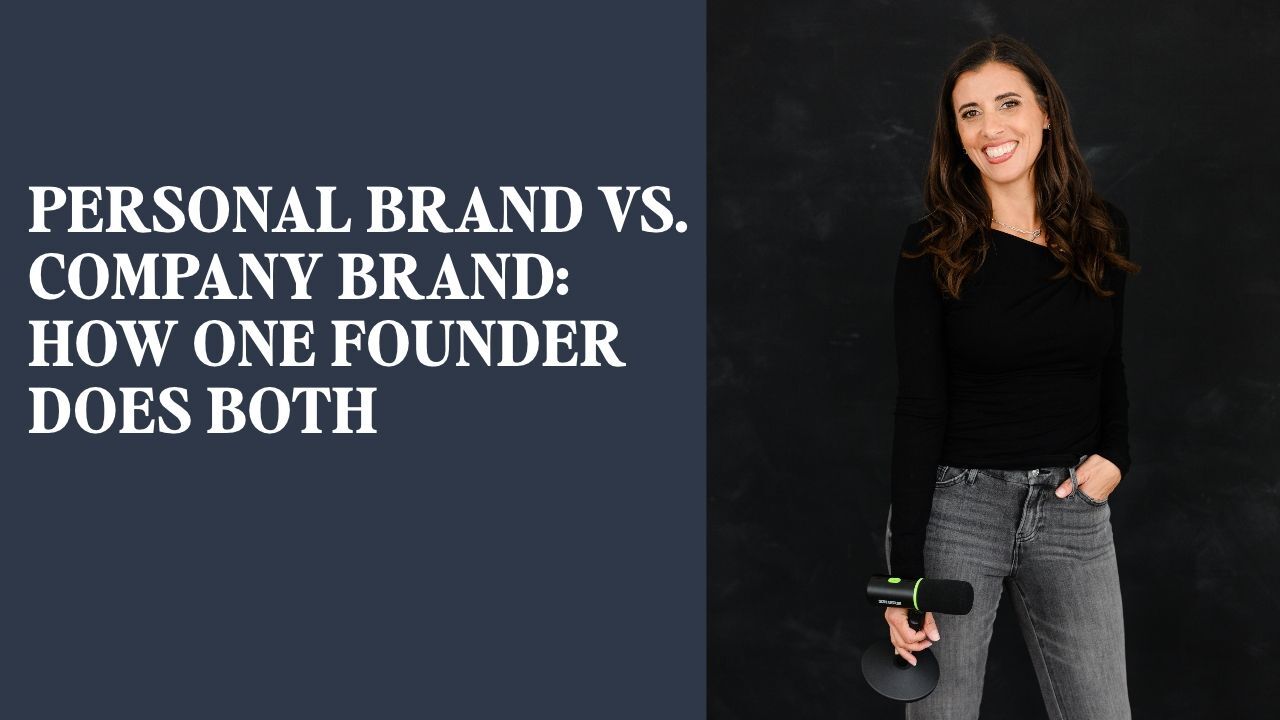
When a business starts to grow, a lot of founders assume the next step is to step out of the spotlight. The team takes over marketing, the company gets its own voice, and the founder fades into the background. The personal brand vs. company brand question is rarely that simple, and your answer affects how easily people trust you.
Joanna Bacchus has a practical answer. After nearly two decades in wealth management, she sold her practice and founded BIOSTRIPS®, a wellness brand centered on sugar-free, oral-dissolving supplement strips. She runs it with a lean team of contractors, and she gives herself and the company separate jobs. The company tells its own story. Joanna, as lead formulator, teaches.
In this conversation on The Branded Impact Podcast, Joanna and I cover how she got here: the list of everyday frustrations that became a product, the one hero product behind her direct-to-consumer launch, and the partners she brings in because they already serve the people she wants to reach. We also get into content—specifically how her team audits what has already worked and turns one long-form piece into a full batch of posts.
If you run an established business and your visibility plan feels heavier than it should, there’s a lot here to borrow.
Five Takeaways from Joanna Bacchus on Building a Founder-Led Brand
-
Write down what frustrates people about your category, then turn that list into your requirements.
-
Give your founder platform a job that’s different from your company’s.
-
Focus the launch. Joanna tested many prototypes, then took one hero product to market direct to consumer.
-
Partner with people who already serve your ideal client, and give them something practical to share.
-
Review past content by hook, presentation, and length before you plan anything new.
Personal Brand vs. Company Brand: How to Give Each One a Job
Joanna describes the business as part of her brand and her brand as part of her personal brand. They overlap, but as she puts it, “they each have their own silo.”
On the BIOSTRIPS® side, people want the founder story, the behind-the-scenes, and how the ingredients were chosen. On her personal side, Joanna is the formulator. She talks about ingredients she’s researched—including ones she isn’t selling yet—using educational green screen videos and resources people can save and share. She says her audience is full of people trying to understand how things work, and they want someone to pull the research together.
She chose not to be the main face of BIOSTRIPS®. Instead, she lets the brand, her affiliates, and her partners show different people using the product.
I told her what I tell the brands I work with. Some founders say they don’t want to be the face because the business is scaling and now there’s a team. My answer is that you still need to be in there. Your strategy shifts, but people still want to know who designed this and why. Joanna’s setup is a smart version of that.
Consistency matters too. Joanna was clear that the brand has to look good, because that’s the first impression. A visitor who finds you on TikTok Shop, then Instagram, then your website should know immediately they’re in the right place.
Try this week: Make two lists. On one, write what your company should say about your work. On the other, write what clients still want to hear from you directly.
How to Turn Everyday Frustrations into a Product Brief
Joanna didn’t start with a business plan. She sold her practice with no plan, then took advice from four clients who told her the same thing: take something that isn’t working and make it faster, easier, cheaper, or simpler. Her recollection of it: “you need to innovate on something that you see that is not working.”
They told her to sit down with a piece of paper and write down what irritates her. Supplements came to mind first. The week before, a turmeric capsule she’d been testing had burst in her purse.
Her list covered portability, independent third-party testing, ease of taking, absorption, taste, and keeping it sugar-free. When she asked whether anything on the market checked every box, her answer was no. The breath strips she remembered from the 90s and 2000s pointed her to the strip format. A pharmaceutical manufacturer opening a nutraceutical division helped her make a first prototype.
Try this week: Write down every workaround your clients or customers have accepted. Pick the three you could fix and turn them into requirements for your next offer.
Why One Hero Product and a Lean Contractor Team Can Carry a Launch
After stops and starts with compliance, packaging, tasting, and R&D, Joanna launched BIOSTRIPS® at an expo. She tested many prototypes, but today she sells one hero product direct to consumer, a metabolic support strip. She’s working with select wholesalers on a wider list of formulations for distribution and retail.
The team is lean by design. “I wanted to run lean from the very beginning,” she said. Her contractors are spread across several countries, and she plans to add full-time roles as the company grows.
I made the same shift when I left corporate. I came from a world where every role was full time, and learning about independent contractors and fractional support expanded what I could do. If you can’t keep someone busy full time, someone else’s business can use the rest of their time, and everyone wins.
Try this week: List the roles you’ve assumed need to be full time. Pick one and price it as contract or fractional support.
How to Find Partners Who Already Serve Your Ideal Client
“People buy from people,” Joanna told me. She recently launched a healthcare practitioner affiliate program and also works with affiliates through TikTok Shop and Instagram, with practitioners as her primary route. She looks for people who already speak to the audience she wants to reach. She says practitioners feel comfortable partnering because she’s transparent about what’s in the product and uses independent third-party testing.
Then she gives them something to share. She’s building the Metabolic Academy, a resource base of shareable guides and checklists, with 16 guides so far. Some don’t mention BIOSTRIPS® at all. I called it over-delivering on value, and it’s the right instinct. A partner needs something useful to hand to their patients or audience before they need your product.
I’ve started working this way too. The question I ask is whether I can support a partner so their client gets a better experience, instead of both of us chasing the same person alone.
Try this week: Ask a referral partner what question they get from clients most. Build one short resource that answers it, with no pitch in it.
How to Audit Your Content and Repurpose What Already Works
I’ll admit I default to “I need to create something new.” Joanna’s marketing lead interrupted that habit. She audited Joanna’s TikTok account, found a video that had performed well, and told her: “Don’t reinvent the wheel. We already know it works.”
They looked at the hook, how Joanna presented the information, and the length. Then they made five videos in that format on different topics. Followers came to know what to expect, which brought them back.
From there, they tested posting the same video elsewhere. Joanna used Repurpose.io, which she says costs about $10 a month, to post to Instagram and YouTube Shorts. She’s now trying Blotato, about $20 a month by her estimate, which writes platform-specific captions. The result was audiences on Instagram, YouTube, and Pinterest that she didn’t know she had. Her advice: “test your creatives across different social media channels.”
As I told her, each platform draws a different demographic, and evergreen content keeps working, especially on search-driven platforms like Pinterest.
Try this week: Pull up your best-performing post. Write down its hook, how you delivered it, and its length. Outline five posts in that format on new questions.
How to Repurpose Content with AI Starting from One Long-Form Idea
Joanna writes long-form pieces, sometimes white papers, and treats each as a hero piece. She gives it to Claude, which recommends hooks and drafts ideas for carousels, graphics, infographics, short videos, and versions for LinkedIn, Medium, and Reddit. She edits everything and checks compliance, and she says you can build guardrails into the setup. She estimates one piece can become 40.
Her advice for choosing the topic: “Find one key piece that your audience is asking.”
My take is that the starting point matters most. Begin with your own original idea, then use AI to speed up the rest. If you don’t write white papers, write one blog post that answers a question your ideal clients ask often. Then pull carousels and scripts from that post. I’m a batch creator and I prefer evergreen to chasing trends.
Try this week: Write down the question your ideal clients ask most. Draft one post that answers it.
FAQ
Do you still need to be the face of your brand when you have a team?
You don’t have to be the main face, but you should stay part of the story. Joanna lets BIOSTRIPS®, her affiliates, and her partners carry much of the visual presence while she teaches as lead formulator. I tell the brands I work with that your strategy shifts as you grow, but you still need to be in there.
How do you decide which content to repurpose?
Start with what already performed. Joanna’s marketing lead reviewed the hook, presentation, and length of a high-performing video, then had her make five more like it on different topics.
Can you use AI to repurpose content without it sounding generic?
Joanna starts with her own long-form writing, uses AI to generate hooks and drafts, then edits and checks compliance before anything goes out. I’d add that the original idea should be yours, and AI speeds up everything after it.
What This Means for Your Brand or Business
Three things stand out from this conversation. Your offers and your content improve when they start from something real: a workaround people accept, or a post people already responded to. A growing team doesn’t mean you disappear. It means you decide what only you should explain. And the assets that travel furthest are practical: a guide a partner can share, a format your audience already likes, one long-form piece that feeds many smaller ones.
Listen to the Full Conversation
Joanna goes deeper on all of this, including the tools her team uses and how she builds partner resources. Listen or watch the full episode here: Spotify | Apple Podcasts | YouTube
About Joanna Bacchus
Joanna Bacchus is the founder of BIOSTRIPS®, a wellness brand centered on sugar-free, oral-dissolving supplement strips. She spent nearly two decades in wealth management before selling her practice, and she also went back to school and became a holistic nutritionist. As lead formulator, she shares ingredient education on TikTok and subject-matter content on oral-dissolving strip technology on LinkedIn.
-
Website: www.biostripshealth.com
-
LinkedIn: www.linkedin.com/in/joannabacchus
-
Instagram: https://www.instagram.com/joanna.bacchus/
About The Branded Impact Podcast
The Branded Impact Podcast explores the intersection of brand, business, visibility, and growth through real conversations with entrepreneurs and experts who are building businesses designed to make an impact.
Hosted by Jo Espejo, Founder of Branding by Jo.
Ready to Strengthen Your Own Brand?
Not sure what’s holding your brand back or the next steps to take your business to the next level?
Take the Branded Impact Scorecard to uncover where your brand is strong, where there are gaps, and what to focus on next.






Comments +